
Surgical drains have existed since the ancient Greeks first practiced medicine, but the issues they present have persisted for centuries.
A future Longhorn M.D., supported by an innovative medical education curriculum and a partnership with one of the nation’s leading engineering schools, is bringing the solution to market, improving care for patients and providers alike.
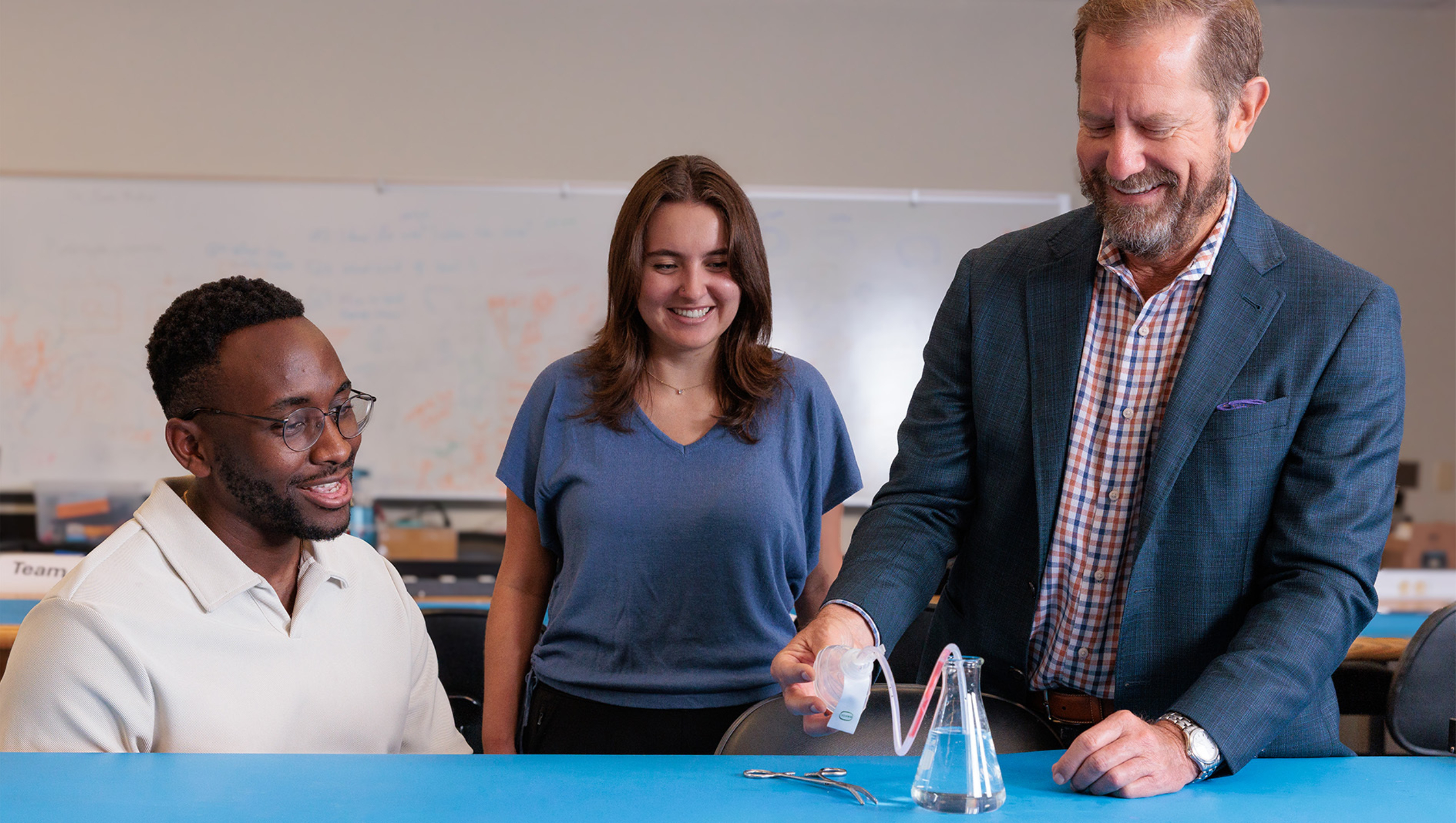
Left to right: Jordan Tanyi, Natalie Zeakes and John Uecker, M.D., demonstrate a Jackson-Pratt surgical drain, a medical device that helps close and heal surgical wounds. The Jackson-Pratt drain is the most commonly used type of surgical drain and the kind that the Drain+ innovators are modifying.
As part of Dell Medical School’s accelerated curriculum, students gain clinical experience in their second year and learn in hospitals and clinics around Austin.
It was then, when Jordan Tanyi, Class of 2027, first noticed that surgical drains were a thorn in postoperative care.
Surgical drains use a simple design: A tube is placed in a surgical wound and connected to a bulb that draws away secreting fluid while a patient recovers. When drains work as intended, they reduce inflammation and allow wounds to close and heal carefully. When they don’t, they clog and complicate recovery.
Tanyi saw how clinicians regularly reported adverse outcomes caused by clogged drains. In some cases, fluids pooled around surgical wounds with nowhere to go, resulting in infections. In others, patients struggled to clear blockages consistently while at home (imagine pushing up the dregs of toothpaste from the bottom of a near-empty tube).
“When a drain is clogged by debris, you reduce the total amount of fluid that should otherwise be removed and create a stagnation of nutrient-rich material liable for infection,” Tanyi says. “Clogs also cause conditions like skin necrosis and can lead to longer stays in the hospital and more time using a drain.”
Now at the end of his third year of medical school, Tanyi is leading a team designing a device that solves the downstream complications of clogs by preventing them altogether.
Study medicine, engineer change
For his Growth Year — the hallmark of Dell Med’s M.D. program that allows students to explore additional academic interests like dual degrees, research projects and technology commercialization — Tanyi pursued a master’s in biomedical engineering and participated in the Clinical Biodesign program, a collaboration between Dell Med and the Cockrell School of Engineering that pairs third-year medical students with graduate-level engineers to shape new and meaningful innovations in healthcare.
The program immersed Tanyi and his engineering peers Natalie Zeaks, Cody Callahan and Vivek Keval in clinical settings and tasked them to find unmet needs with potential for a technology-based solution. During their time on surgical floors, the team saw the same thing Tanyi did during his clinical clerkships: care teams and patients burdened by clogged drains.
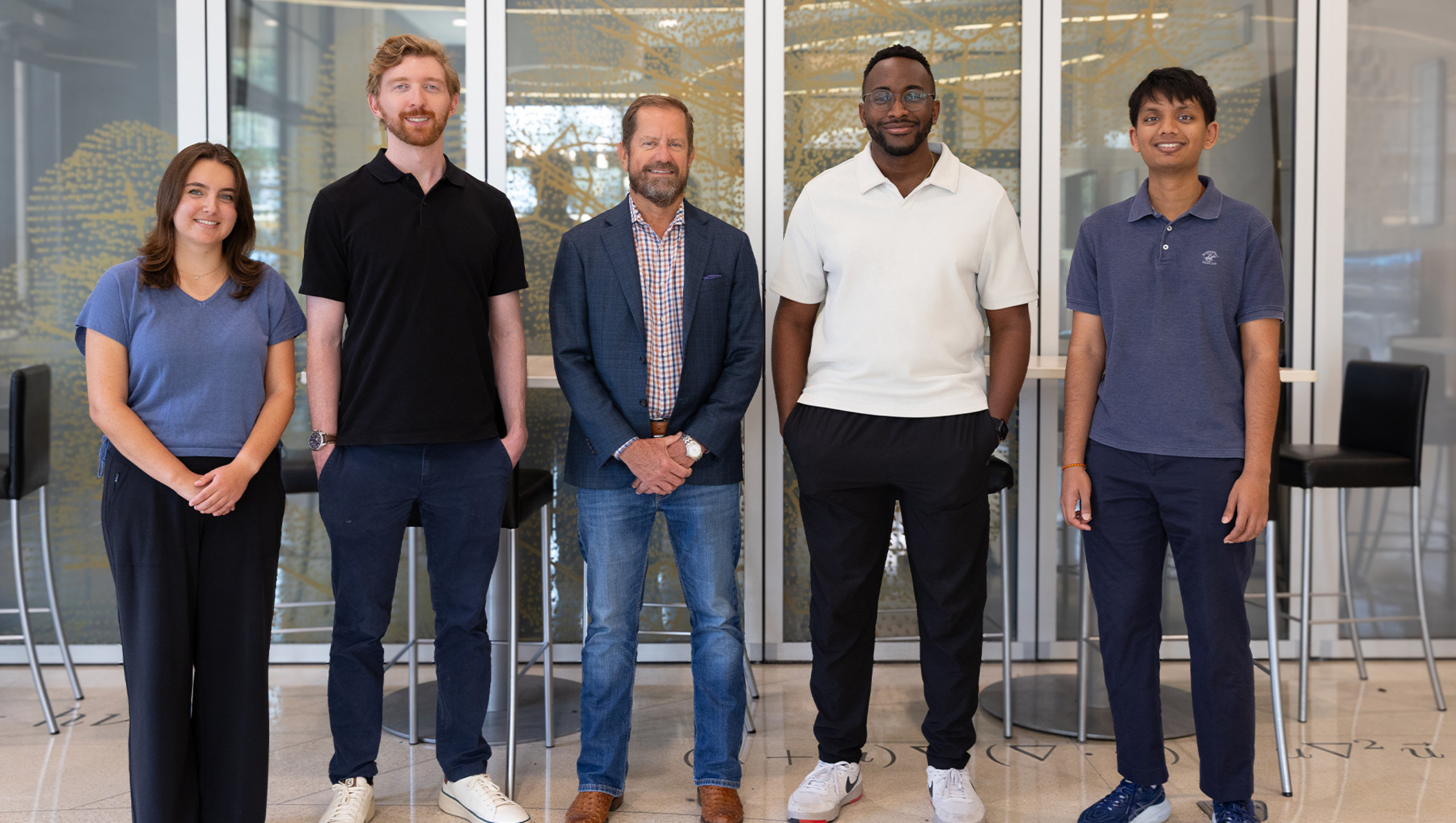
Students work with a faculty mentor in a specific service area to define the clinical challenge they’re trying to solve and refine their innovation for clinical and commercial success. The Drain+ team, left to right: Natalie Zeakes, Cody Callahan, John Uecker, M.D., Jordan Tanyi and Vivek Keval.
Over a nine-month period, Tanyi and his team melded cross-disciplinary perspectives, skills and knowledge to create Drain+, a small clip-on device that attaches to standard surgical drains and uses gentle vibrations to prevent clogs before they form.
The device’s vibrations are calibrated to maintain a consistent suction force within the drain, ensuring a steady flow of fluid and removing the need to manually clear blockages. And with a user-friendly design that attaches externally, Drain+ gives patients autonomous drain management at home while completely avoiding interference with the sterile fluid path inside the tubing, reducing the risk of infection.
“What we did was enhance the function of existing drains rather than create a new tool everyone has to familiarize themselves with,” Tanyi says. “We wanted to create a solution that doesn’t disrupt anyone’s day, which is what often becomes a barrier to widespread adoption.
“With Drain+, you have a system where nurses, physicians and patients don’t have to worry about constantly clearing blockages. You get more consistent management of drains and, ideally, have more cases where drains are removed earlier in the recovery process because wounds heal without disruption.”
Practical solutions for unmet needs
The progression from observation to innovation is at the heart of the Clinical Biodesign program.
Throughout the nine-month class, faculty mentors prompt innovation teams like Tanyi’s to systematically build a clinical solution using real-time feedback from physicians, scientists, designers and business experts.
Industry professionals from the University’s Discovery to Impact startup program work with the students to help them define their intellectual property and plan for the regulatory challenges that they can expect when translating their tools out of the University.

Aspiring engineers, physicians and innovators benefit from close collaboration between Dell Medical School and the Cockrell School of Engineering. Launched in 2020, the Clinical Biodesign program provides engineering and medical students the opportunity to work together to develop commercially sound solutions for common, observable challenges seen in clinical settings.
By the end of the program, innovations like Drain+ continue their path to market commercially sound and designed around the clinical problem the students saw firsthand.
“The Clinical Biodesign program teaches third-year medical students and graduate engineering students the various steps of getting an idea about a medical device into the clinical environment,” says John Uecker, M.D., a faculty mentor in the program and professor of surgery and perioperative care and clinical professor of biomedical engineering. “This includes voice-of-customer work, prototype development, filing patents, learning the regulatory pathway and preparing them to commercialize their products.
“It is a unique program that distinguishes Dell Med from most other medical schools across the country.”
The business of medical innovation
To help move Drain+ into hospitals and patients’ homes, Tanyi and his team are receiving support from Texas Health Catalyst, Dell Med’s flagship program for health product innovation.
In the spring, they applied to the program’s biannual funding and mentorship cycle, which selects promising ideas and innovations from around the University and provides strategic funding, commercialization guidance and connections to clinical and industry advisors. They worked with Dell Med faculty to further refine their business strategy and define outcomes for potential buyers.
“One of the most exciting things about Texas Health Catalyst is seeing innovators recognize a problem in the clinic and providing them with the specialized mentorship and commercialization support needed to turn that insight into a solution that can improve patient care,” says Nicole Clark, director of innovation and entrepreneurship at Dell Med. “The Drain+ team’s work is exactly what we’re striving to cultivate — innovators who understand both the clinical need and the path to bringing meaningful technologies into the hands of patients and providers.
“It’s a wonderful example of what can happen when talented students are empowered with the right mentorship and resources at the right time.”

Texas Health Catalyst’s “Roundup and Rodeo” event recognizes promising medical innovations from faculty and student innovators around the University. The program, led by Dell Med’s Office of Innovation and Entrepreneurship, supports innovators like Tanyi with clinical and industry advising, milestone-based funding, and mentorship to help move their ideas to market
During the University’s innovation week, a campus-wide celebration of student and faculty entrepreneurship, the Drain+ team took part in Texas Health Catalyst’s pitch competition. They competed against seven other innovation teams and presented Drain+’s commercial viability to judges with commercialization expertise and an audience of venture capitalists and prospective collaborators.
Tanyi and his team took home the competition’s Pioneer Award, which recognizes the pitch that defines a clinical problem and proposed solution with exceptional clarity and precision. Along with the award, they’re receiving milestone-based funding to now work on prototypes for Food and Drug Administration testing and approval.
“The beauty of programs like Clinical Biodesign and Texas Health Catalyst is that you’re surrounded by a team that has a stake in every sector of what it takes to commercialize an idea: physicians, IP lawyers, industry advisors and regulatory experts,” Tanyi says. “The experience was so beneficial in giving me the skills to look at a problem and devise the ways it can be fixed.
“I think that’s a very powerful thing for a physician to have.”