
Pancreatic cancer hides deep within the body. By the time symptoms appear, the disease has already reached grave lengths, and patients face a five-year relative survival rate of 13%, making it one of the deadliest.
A new translational science partnership is tracking cancer’s footprint through metabolism, which may just lead to crucial early detection, better treatment monitoring and personalized therapeutics.
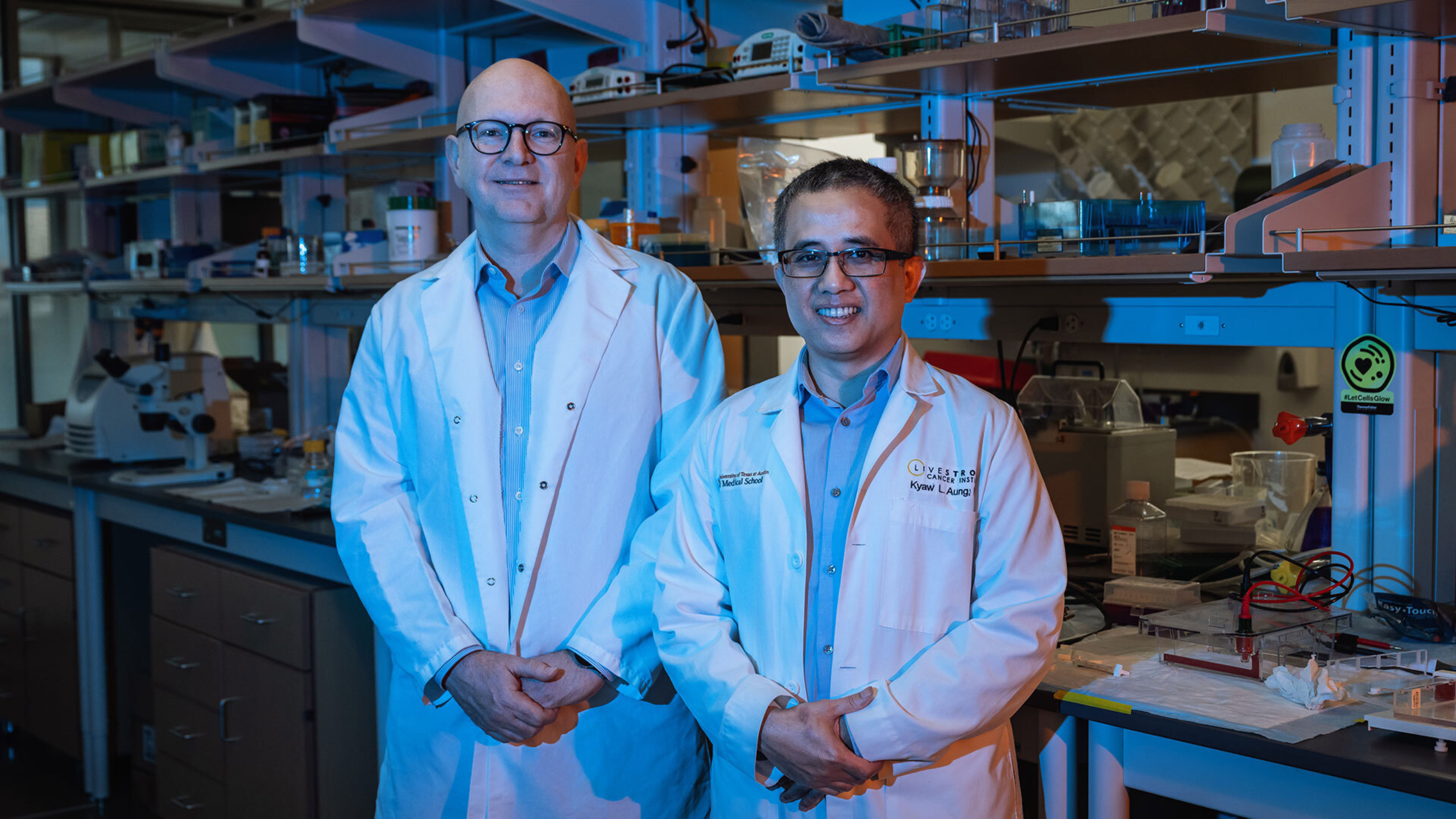
Stefano Tiziani, Ph.D., and Kyaw Aung, M.D., Ph.D.
There are no recommended screenings for pancreatic cancer. At the time of diagnosis, most patients have a metastatic form of the disease, leaving curative surgery out of reach. Looking to discover and exploit any vulnerabilities in the cancer’s growth pattern are Kyaw Aung, M.D., Ph.D., and Stefano Tiziani, Ph.D.
Aung, an assistant professor in Dell Medical School’s Department of Oncology, and Tiziani, a professor in the Department of Nutritional Sciences within the College of Natural Sciences, are leveraging Dell Med’s clinical infrastructure to analyze the metabolic environment of cancer patients and learn how the body’s biomarkers can be used against the disease.
The team maps a patient’s cancer by collecting blood samples, tumor cells and neighboring healthy cells. Combined, the samples reveal intricate clues into how the cancer is behaving in the body, which can then be used to alter treatments and aid diagnoses.
“We have a unique opportunity to analyze what’s happening inside a tumor and compare and contrast that to characteristics found in the blood and healthy tissues,” says Aung, who also received an Early Career Investigator Award from the Cancer Prevention & Research Institute of Texas to help establish a pancreatic cancer research program at UT. “We’re using blood biomarkers to deeply understand the tumor and what they may signal about a patient’s prognosis and response to treatment.
“The holy grail of pancreatic cancer research is whether we can detect anything early. There is a window of opportunity where we could potentially detect subtle metabolic changes in the blood.”
Throttling cancer’s diet
The team is brought together through a pilot grant from Dell Med’s Health Transformation Research Institute and Texas Biologics — initiatives that enable transdisciplinary research and connect physician-scientists like Aung with expert researchers on campus like Tiziani to uncover mechanisms of disease and more.
Tiziani’s chemical biology research has shown how cancer’s altered metabolism is open for attack by therapies that target cancer cells’ fuel supply, which he looks to apply in his work with Aung.
“Every cancer requires nutrients to proliferate. When you deprive fuel, you’re either able to cure, slow down or sensitize cancer cells to make other drugs more efficient, or even reduce the toxicity of chemotherapy,” Tiziani says. “The beauty of this project is that from within the same patient, we’re able to independently profile a cancer side and a ‘normal’ side, and detect what a patient’s cancer cells require to proliferate and what they’re doing to bypass chemotherapy treatment.
“By targeting these metabolites, we can develop a treatment strategy and build drug interventions that are specific to the patient.”