
A partnership between Dell Medical School and the School of Nursing at The University of Texas at Austin is leveraging research findings to improve the way dementia patients and their families transition from hospital to home.
Judy and Gene shared 57 years of marriage. For most of that time, their life together moved at a steady, familiar pace — but as Gene began to experience dementia, illness started to shape their days.
The changes were gradual at first, woven into daily life in ways they could manage. Then his health declined, and the pace of decisions — hospital visits, consultations and difficult conversations — quickened.
“He lost his reasoning power and ability to think things through,” Judy said.

Left to right: Jung Kwak, Ph.D., and Sarah Stayer, M.D.
Somewhere in that cycle of admissions and uncertainty, she connected with a community health worker through a pilot program called Connecting and Empowering Persons Living with Dementia and Caregivers during Transition, or CEDART — a collaboration between Jung Kwak, Ph.D., principal investigator and associate professor in The University of Texas at Austin School of Nursing, Sarah Stayer, M.D., coinvestigator and hospice and palliative medicine fellowship program director at Dell Medical School, and Ascension Seton hospitals.
Having someone who understood the system and could help Judy navigate it made a meaningful difference. That steady presence reflects the core of the program’s design.
Filling the gap families described
CEDART emerged from Kwak‘s and Stayer’s prior research, which consistently highlighted unmet caregiver needs during hospital-to-home transitions.
“Our earlier research kept pointing us back to the same question: What do families actually need?” Stayer said. “This study was designed to fill those gaps. Being patient-centered and interdisciplinary means listening to what patients and caregivers say they need and then building the support to meet it, using people with both cultural understanding and medical knowledge to serve as that connector.”
Rather than creating a parallel system, the program embedded this role directly into hospital care teams. Residents, fellows and medical students supported identification and screening, but the model centered on community health workers, who participated in interdisciplinary rounds and served as the primary bridge between clinicians and families — translating coordination into real-world support during the transition home.
When home doesn’t feel ready
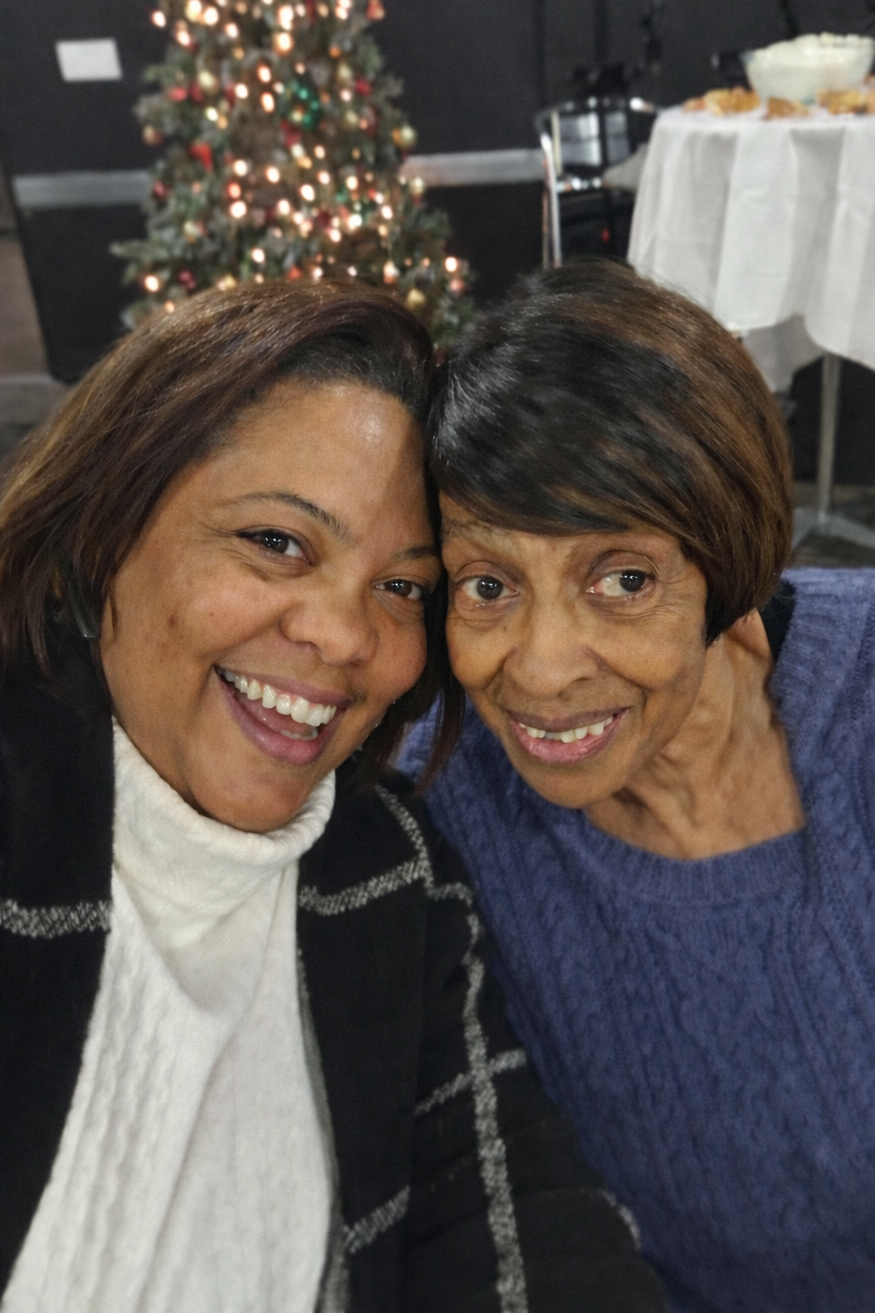
Nichole with her mother.
For families, that shift can feel overwhelming. Nichole cares for her mother, who is living with multiple chronic conditions and moderate dementia. “The transition home from the hospital was one of the hardest parts,” she said.
During hospitalization, she struggled to secure the right supports and had to advocate for additional help before connecting with social work and palliative care.
“I needed support at home, and resources,” she said. “This program provided that for me in spades.”
The CEDART pilot served community-dwelling older adults with dementia and their caregivers — many of whom entered the program with limited dementia knowledge and high levels of emotional, physical and financial stress. The intervention was delivered in both English and Spanish, reflecting the diversity of families navigating hospital-to-home transitions.
For Judy, support came during an especially painful period. At one point, the community health worker arranged a call with an Alzheimer’s specialist to help her understand the rapid changes she was seeing in Gene.
“That connection made a hard time feel less lonely,” she said. She had wondered whether his acute illness was accelerating the dementia; the specialist reassured her that such rapid decline during serious illness is common — the first time anyone had clearly explained that to her.
From reactive to supported
CEDART begins in the hospital and addresses the clinical realities of dementia, but its impact extends far beyond medical care — into the lived experience of families at home.
For Nichole, the presence of a community health worker shifted the experience from reactive to supported.
“Having a CEDART community health worker felt like finally having someone on our side who knew the system and cared about our reality,” she said. “They didn’t just give information; they walked with us.”
She recalled one moment in particular: Follow-up appointments and community resources were coordinated before discharge so they were not left scrambling at home.
“That kind of support changed everything,” she said. “It felt like someone had turned the lights on in a very dark hallway.”
What the data shows
Early findings from the 12-week pilot suggest the approach is doing more than offering reassurance.
Caregivers showed statistically significant improvement in self-efficacy — their confidence in managing care — while caregiver burden declined. Stress levels remained stable despite high baseline strain.
“One daughter told us she finally got clear guidance on qualifying her mom for Medicaid — something she’d been struggling with for years,” Kwak said. “Another caregiver shared that our support helped her mom pass in peace, surrounded by love.
“Those moments reminded me how small connections can make a huge difference for families,” she said.
Among the pilot’s 34 dyads — a caregiver and a person living with dementia — engagement was strong, with over 80% session attendance among those who remained active. Most dyads who left the study did so because of serious health decline or death. Caregivers gave the program an average rating of 4.5 out of 5.
Looking beyond dementia
While CEDART is rooted in dementia care, Kwak sees it as a blueprint for strengthening support after hospitalization across conditions, from heart failure and stroke to other chronic illnesses.
“To grow, we need sustainable funding and ways to integrate community health workers into hospital discharge teams,” Kwak said. “The biggest hurdle is system-level — building a workforce, creating reimbursement models and showing hospitals that community health workers aren’t ‘additional or extra,’ but essential partners in safer transitions and better patient care.”
For caregivers like Nichole, the value is immediate.
“You do not have to do this alone, and you shouldn’t,” she said. “Programs like CEDART can change the entire trajectory of your caregiving journey.”
For Judy, the recommendation is quieter but just as firm.
In the final months with Gene, a community health worker’s steady voice on the other end of the phone made a difference.
“It was helpful to have someone to talk to,” she said.
And in dementia care, that may be where better outcomes begin.